Retail Banking | Current Account
NatWest

Role
Senior Product Designer
Product Team
Retail Bank | Current Account
Duration
9 months
Project
Problem
NatWest's Current Account application journeys were being re-platformed, but there was no unified design ownership holding it together. Multiple journey variants had accumulated inconsistencies, unresolved usability issues, and no alignment to the incoming brand refresh. This part of the business, which fell outside of the broader UCD team, was not mature in Design Thinking foundations, which presented the opportunity to help navigate constraints better, and Consumer Duty was arriving with a new regulatory requirement that had not yet been designed for.
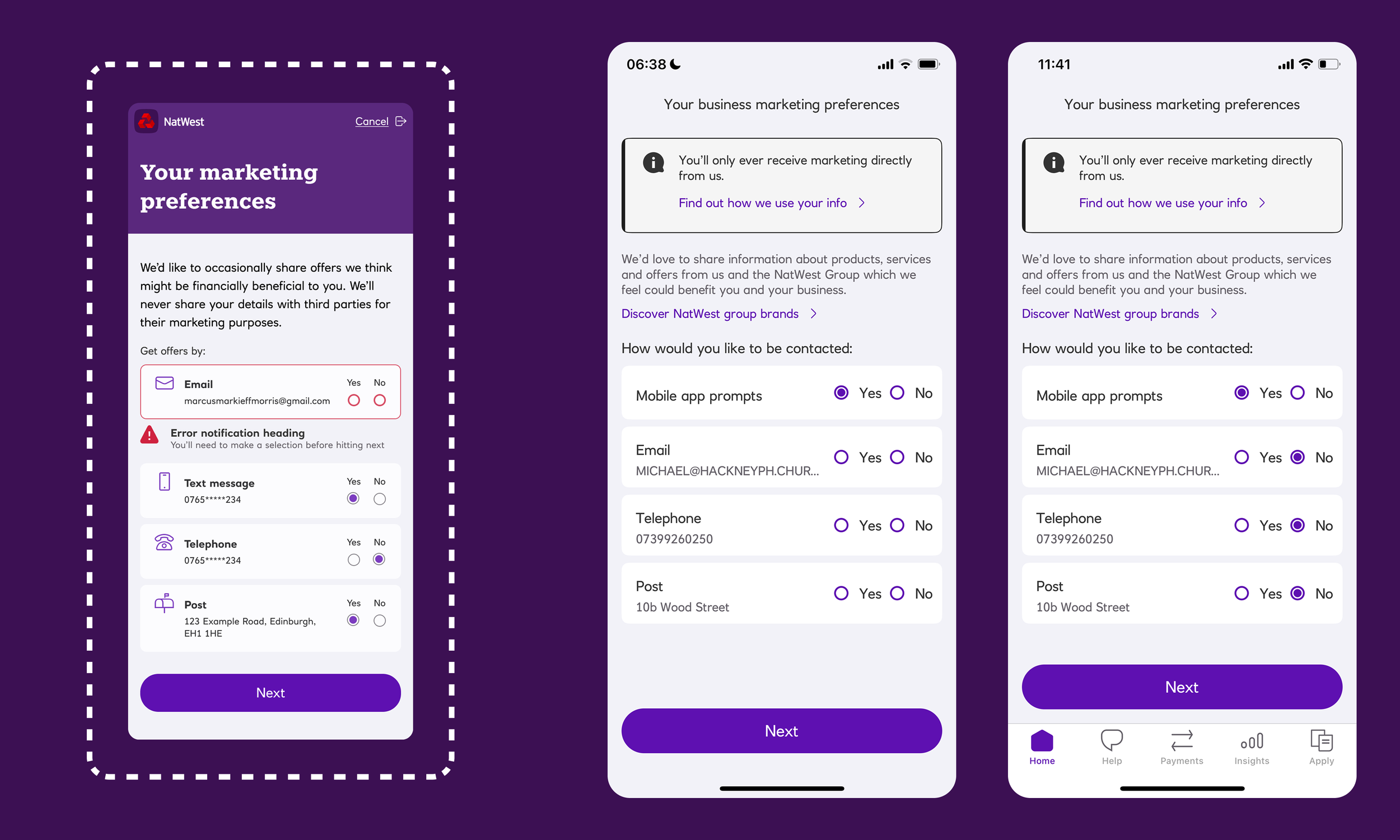
Consumer Duty changed the rules. Marketing preferences could no longer be buried in a journey or defaulted — customers had to actively make a choice. That was the regulatory floor. The design problem was harder: how do you build a mandatory-choice screen into a high-stakes current account application without haemorrhaging the commercial funnel?
The risk was obvious. Heavy-handed compliance screens at a critical point in an acquisition journey create friction, signal distrust, and generate drop-offs. I flagged this early. The answer wasn't to soften the requirement — it was to design something that made the choice feel meaningful rather than coercive.
Solution
As the sole designer embedded in the team, I owned the re-platforming end-to-end: harmonising the brand refresh across variants, resolving longstanding usability issues, and designing a research-validated solution to meet the Consumer Duty marketing preferences requirement. I also extended my remit — without being asked — into team capability building, Design System advocacy, apprentice mentorship, and senior stakeholder engagement. The gaps were there, so was the opportunity to own them.
Process
-
I reviewed each journey variant systematically, mapping inconsistencies and flagging components that hadn't kept pace with the new brand direction. In parallel, I worked with designers across other NatWest teams to establish how the new Design System components should translate into our specific journeys — so we weren't making component decisions in isolation once delivery started.
Very quickly, I spotted that the onboarding question set wouldn’t meet FCA or Consumer Duty standards. Working closely with BAs and the Senior Propositions Manager, I mapped regulatory requirements and identified gaps, enabling us to redesign the journey compliantly without compromising the experience.
-
Consumer Duty introduced a hard requirement: mandatory choice for marketing preferences had to be built into the journey. I flagged early that meeting it badly carried real commercial risk to the acquisition funnel. The goal wasn't to resist compliance; it was to design something that met the regulatory intent without manufacturing drop-offs.
Qualitative research validated the design direction, but the stakes of the change — and its potential funnel impact — meant we needed quantitative data to back it up. I worked with the Senior UX Researcher to define the metrics that mattered most and frame the research around funnel impact, getting the study scoped and signed off. That rigour gave stakeholders the confidence to move forward.
I also delivered Design Thinking coaching to my immediate team throughout, which shifted how they engaged with constraints and moved toward resolutions across the sprint cycle.
-
The Consumer Duty marketing preferences screen was the centrepiece — designed to go through both qualitative and quantitative research before anything went near Dev. Getting there required more than design work.
A parallel workstream had begun designing the same experience independently, with their Dev team flagging the proposed change as too technically complex to implement. I wasn't convinced. I sat down directly with one of our Developers to map the complexity properly — what the change actually required, what the real implementation impact was, and where the perceived risk was being overstated. That conversation gave us the evidence we needed. I escalated to stakeholders, got the right people on a call, and we came out of it with sign-off to proceed with the research-validated approach.
-
Having identified information architecture issues in the initial designs, I explored several directions for the redesigned experience and presented the options to stakeholders before committing to a test-ready version. Getting alignment at that stage meant the research wasn't validating assumptions — it was testing a considered, stakeholder-backed design.
The prototype itself required building every user choice outcome manually. Anonymising the branding for testing meant no shortcuts through the tooling, so I designed the full pattern by hand to hit the research deadline — every state, every path, production-ready.
I partnered with both the internal Senior UX Researcher and an external research outfit to execute the user testing, and co-authored the research findings document with the internal researcher. With the qualitative direction confirmed, I then led the approach to a quantitative study aimed at generating funnel impact metrics on the redesign — producing two prototype variants, one branded and one unbranded, to isolate whether the NatWest brand context was influencing behaviour independently of the design. That distinction mattered for how we interpreted the data.
Running qual and quant in sequence — each informing the other — turned a compliance deliverable into a proper evidence base. The redesigned marketing preferences screen is now live in the NatWest mobile app.
UX Apprentice Mentorship | Filling The Gap
Outside my core project work, I voluntarily mentored a cohort of 8–12 UX apprentices within NatWest. The apprenticeship programme had a structural gap: the apprentices weren't getting meaningful exposure to live design work, and the learning support wasn't keeping pace with what they needed to actually develop. I ran sessions, reviewed work, and gave feedback grounded in what the industry expects — not what a programme outline says.
Where I identified structural issues in how the programme was being run, I escalated them to senior leadership. Not to make noise — because fixing a systemic problem required someone with the authority to act on it, and the right move was to get it in front of the right people.
Many of those apprentices have completed their apprenticeships and are now working in a UX capacity within NatWest or have gone on to secure mid-level roles elsewhere.
900 Days of UX Progress | Design Thinking Education
I delivered a senior leader spotlight built around an industry article tracking NatWest's UX progress since a previous benchmark. The brief I gave myself wasn't retrospective — it was diagnostic: where did the gaps still sit, what was in our gift to fix, and where were the quick wins we hadn't moved on? I brought that into a room of senior leaders and stakeholders and laid it out clearly, opening a conversation about design's role that hadn't previously sat at that level.